As a parent, keeping your child safe is always a top priority—especially when you're on the road.
Choosing the right car seat, and using it correctly, makes a big difference.
Use these tips from the American Academy of Pediatrics to make sure your child's car seat provides proper protection in a crash.
✅ Does your car have air bags?
Never place a rear-facing car seat in the front seat of a vehicle that has a front passenger
air bag. If the airbag inflates, it will hit the back of the car seat, right where your baby's head rests. This impact could cause serious injury or death.
The safest place for all children younger than
age 13 to ride is in the back seat, regardless of weight and height.
If an older child must ride in the front seat, a child in a forward-facing car seat with a harness may be the best choice. Be sure you move the vehicle seat as far back from the dashboard (and air bag) as possible.
✅ Is your child facing the right way for weight, height and age?
All infants and toddlers should ride in a rear-facing car safety seat for as long as possible, up to the highest weight or height allowed by their car safety seat manufacturer. Most infants will outgrow rear-facing-only car seats by length long before they reach the maximum weight limit. When infants outgrow a rear-facing-only seat, they should use a rear-facing convertible seat. Most convertible seats have limits that will allow children to ride rear facing for 2 years or more.
When a child exceeds the rear-facing weight or height limit for their convertible car safety seat, they should use a forward-facing seat with a harness for as long as possible—up to the highest weight or height allowed by their car safety seat manufacturer. Most car seats can accommodate children up to 65 pounds or more.
✅ Is the harness snug?
Harness straps should fit snugly against your child's body. Check the car seat instructions to learn how to adjust the straps.
Place the chest clip at armpit level to keep the harness straps secure on the shoulders.
✅ Does the car seat fit correctly in your vehicle?
✅ Should you use the LATCH system?
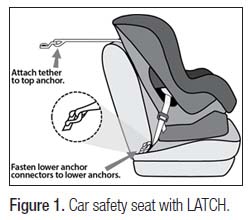
Car safety seats may be installed with either the vehicle's seat belt seat belt or its LATCH (lower anchors and tethers for children) system. Both systems are equally safe. So caregivers should use one or the other, whichever works best for them, their car safety seat and their vehicle.
In general, caregivers should use only 1 of the 2 options, unless the car safety seat and vehicle manufacturers say it is OK to use both systems at the same time.
Vehicles with the LATCH system have anchors located in the back seat, where the seat cushions meet. All car seats have attachments that fasten to these anchors. Nearly all passenger vehicles made on or after September 1, 2002, are equipped to use LATCH. All lower anchors are rated for a maximum weight of 65 pounds (total weight includes car seat and child). Check the car seat manufacturer's recommendations for the maximum weight a child can be to use lower anchors. New car seats have the maximum weight printed on their label.
The top tether improves safety provided by the seat. Use the tether for all forward-facing seats. Check your vehicle owner's manual for the location of tether anchors. Always follow both the car seat and vehicle manufacturer instructions, including weight limits, for lower anchors and tethers. Remember, weight limits are different for different car seats and different vehicles.
✅ Should you use a top tether?
The top tether does a great job of improving safety provided by the car seat. Use the tether for all forward-facing seats up to the highest weight allowed by your vehicle and the manufacturer of your car safety seat. Your vehicle owner’s manual will tell you how to find the location of tether anchors.
Remember, weight limits are different for different car safety seats and different vehicles. So, it is important to check both the car safety seat and vehicle manufacturer instructions for lower anchors and tethers.
✅ Is the seat belt or LATCH strap in the right place and pulled tight?
Route the seat belt or LATCH strap through the correct path for the car safety seat. Convertible seats have different belt paths for when they are used rear facing or forward facing (check your instructions to make sure).
If you install the car seat using your vehicle's seat belt, you must make sure the seat belt locks to keep a tight fit. In most newer cars, you can lock the seat belt by pulling it all the way out and then allowing it to retract to keep the seat belt tight around the car seat. Many car seats have built-in lock-offs to lock the belt. Check your vehicle owner's manual and car seat instructions to make sure you are using the seat belt correctly.
Pull the belt tight. Apply weight into the seat with your hand while tightening the seat belt or LATCH strap. When the car seat is installed, be sure it does not move more than an inch side to side or toward the front of the car.
✅ Has your child outgrown the forward-facing seat?
-
All children whose weight or height is above the forward-facing limit for their car seat should use a belt-positioning booster seat until the vehicle seat belt fits properly. While this is typically when they have reached 4 feet 9 inches in height and are 8 through 12 years of age, every kid is different. It is important to make sure to check how a seat belt fits your child in each car they will be riding in.
A seat belt fits properly when the shoulder belt lies across the middle of the chest and shoulder, not the neck or throat; the lap belt is low and snug across the upper thighs, not the belly; and the child is tall enough to sit against the vehicle seat back with their knees bent over the edge of the seat without slouching and can comfortably stay in this position throughout the trip.
✅ Has the car seat been recalled?
-
You can find out by calling the manufacturer or the National Highway Traffic Safety Administration (NHTSA) Vehicle Safety Hotline at 888/327-4236 or by going to the NHTSA Web site at
NHTSA.gov.
Follow the manufacturer's instructions for making any repairs to your car seat.
Be sure to fill in and mail in the registration card that comes with the car seat. It will be important in case the seat is recalled.
✅ Do you know the history of your child's car seat?
-
Do not use a used car seat if you do not know the history of the seat.
Do not use a car seat that has been in a crash, has been recalled, is too old (check the expiration date or use 6 years from manufacture date if there is no expiration date), has any cracks in its frame or is missing parts.
Make sure it has labels from the manufacturer and instructions. Keep the instructions with the car safety seat.
Call the car seat manufacturer if you have questions about the safety of your seat.
Questions
If you have questions or need help installing your car seat, find a certified child passenger safety technician (CPST) by going to the National Child Passenger Safety Certification website at
http://cert.safekids.org and clicking on "Find a Tech."
More information
Figure 1 adapted from National Highway Traffic Safety Administration.
LATCH Makes Child Safety Seat Installation as Easy as 1-2-3. DOT HS publication 809 489. Published March 2011. Accessed January 13, 2017.