By: Patricia Seo-Mayer, MD, FAAP & Beth Vogt, MD, FAAP
About 1-3% of all infants and children have a condition called vesicoureteral reflux (VUR), which means some of their urine flows in the wrong direction after entering the bladder. When urine flows back up toward the kidneys, it can increase the chance of developing a
urinary tract infection (UTI).
UTIs with fever can make children quite sick and even hurt the kidneys, especially if they occur repeatedly. That's why it's important to diagnose and monitor VUR early and treat it if needed. Here's what parents need to know.
What causes VUR in children?
Most children who have VUR are born with it, and doctors aren't sure of the cause. It appears to happen by chance. Researchers are studying inherited or genetic factors (conditions the children are born with) that may be the cause in some cases.
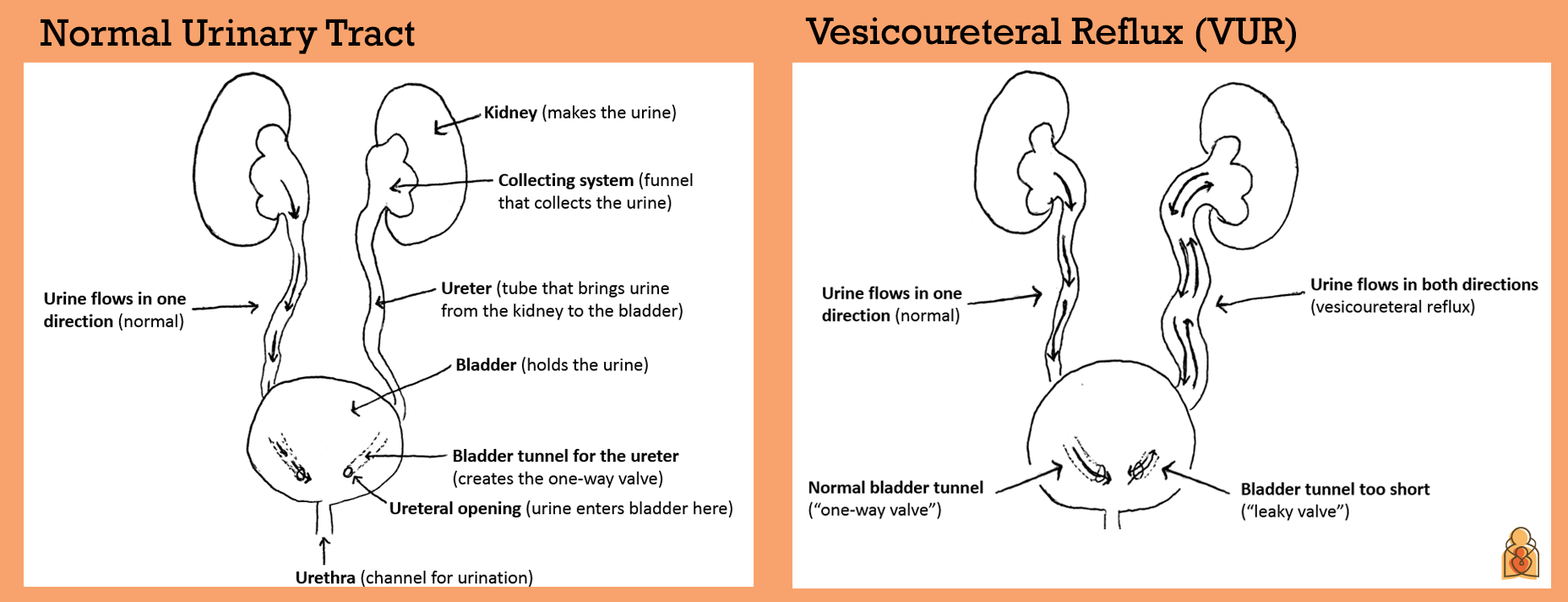
A child's urinary tract is usually a one-way street (see pictures below). The urine flows down from each kidney through tubes called ureters. The ureters enter the bladder through a tunnel inside the bladder wall that creates special one-way valves that prevent urine from going back up into the kidneys. The urine travels out of the bladder through another tube called the urethra.
In children with VUR, the tunnel in the bladder wall may be too short, making the valve "leaky." Urine can travel backward and carry germs into the kidney, causing a kidney infection. VUR can also happen as a result of the bladder not emptying normally. This is a less common cause of VUR.
What are the signs and symptoms of VUR?
VUR doesn't usually cause symptoms until a child develops a UTI.
There are 2 types of urinary tract infections (UTI):
Bladder UTI: These are common and annoying, but bladder infections
(also called cystitis) are usually not harmful to long-term health. Symptoms can include frequent urination or pain with urination.
Kidney UTIs: Kidney infections
(also called pyelonephritis) are more serious and can make a child very sick. Symptoms include high fever, chills, vomiting and back pain. Kidney UTIs can scar the kidneys. In rare cases, the scarring may cause high blood pressure or reduced kidney function.
VUR may also be suspected if a child has hydronephrosis, which is dilation (swelling) of the kidney drainage system caused by the backwards movement of urine. This can be seen on a kidney ultrasound.
Should my child be tested for VUR?
VUR is diagnosed by a test called a
voiding cysto-urethrogram (VCUG). A VCUG is usually done if:
What to expect during a VCUG test:
A thin plastic tube called a bladder catheter is placed into the urethra, and the bladder is filled with a special fluid that can be seen by x-ray. The test is not painful, but the child may experience some stress and short-term discomfort from putting in the bladder catheter.
X-rays are taken as the bladder fills up. VUR is diagnosed if the liquid goes the wrong way up into the ureter and then commonly into the kidney.
What other tests may be done in a child with VUR?
Ultrasound: This test uses sound waves to create an image of a child's kidneys and bladder. It is recommended for all infants and toddlers after their first UTI with a fever.
Dimercaptosuccinic Acid (DMSA) Scan: A DMSA scan can give more detail about whether kidneys have developed scars as a result of kidney UTIs. A doctor may order it if a child has had many UTIs with fever.
Blood test: Creatinine measures kidney function. A high creatinine level suggests that there may be lower than normal kidney function.
Blood pressure: Blood pressure should be checked at least once a year. Children with kidney problems are at higher risk for high blood pressure.
How is VUR graded?
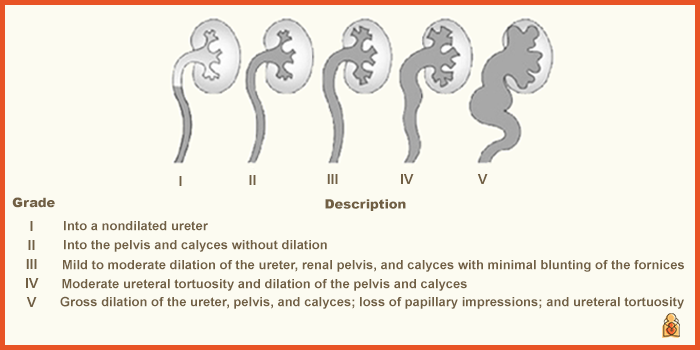
VUR is graded between 1 (mild) to 5 (worst). The grade is based on how far the urine backs up into the ureter and how wide the ureter is. Children who have lower grades of VUR (1-2) found early in childhood have a good chance of outgrowing it within 1 to 5 years.
What kinds of doctors care for children with VUR?
Pediatric specialists who care for children with VUR include:
How is VUR treated?
Treatment for VUR is based on a child's age, the grade of their VUR, and whether it's causing any problems, such as frequent UTIs. In many cases, VUR will get better on its own with age.
Treatment approaches include:
Observation: Children with lower grades of VUR may be safely watched under their doctor's care. This usually involves regular follow-up appointments. It may include ultrasounds to make sure the kidneys are growing normally. Children with VUR should have their urine tested for infection any time they develop a fever and there is no other reason for the fever, like a cold.
Preventative antibiotics (prophylaxis): Some children are given a low dose of an
antibiotic every day to decrease the risk of developing a UTI while waiting to see if they outgrow the VUR. The American Academy of Pediatrics (AAP) recommends considering preventative antibiotics for children with higher grades of VUR (grades 3-5).
Surgery: If VUR is severe and does not get better, or if there are repeated kidney UTIs with fever, a child may benefit from surgery that fixes the leaky valve between the bladder and the ureter. Procedures include:
Ureteral reimplantation: The connection between the ureter and bladder is corrected so that urine flows only in one direction.
Endoscopic injection: A substance is injected into the area where the ureter meets the bladder to prevent backward flow of urine.
These procedures are common, generally very safe, and have excellent long-term success.
What else can parents of children with VUR do?
Continue to help your child with healthy bladder and bowel habits. All potty-trained children with VUR need to work on this to help
prevent UTIs.
Avoid constipation
Many children get
constipated. This is most common around the age of potty training when they are learning to hold their bowels, but can happen at any age. Constipation makes it harder to empty the bladder and increases the risk of a UTI. It is important to avoid or treat constipation.
Discourage "holding it"
Drinking enough water and eating a high-fiber diet may prevent or treat constipation. Some children may need a gentle daily laxative. Children should have a soft bowel movement every day.
It is also important that children completely empty their bladder every 2-3 hours when they are awake. Children should avoid holding their urine for long periods. This helps keep the bladder clean and prevents UTIs.
Know the early signs of a UTI:
If your child has any of these symptoms, call your child's primary care provider. Based on test results, the provider will decide whether your child needs to start treatment with an antibiotic either at home or in the hospital.
Remember
Many children outgrow VUR over time, often by age 5. Finding VUR early and monitoring it closely with your child's doctors--and getting treatment if needed--will help avoid any long-lasting problems.
More information
About Dr. Seo-Mayer
 Patricia (Patty) Seo-Mayer, MD, FAAP, is a pediatric nephrologist at Inova Children's Hospital and an Associate Professor of Pediatrics at The University of Virginia School of Medicine. She is a member of the AAP, Section on Nephrology and is a Council member of the American Society of Pediatric Nephrology (ASPN). Patricia (Patty) Seo-Mayer, MD, FAAP, is a pediatric nephrologist at Inova Children's Hospital and an Associate Professor of Pediatrics at The University of Virginia School of Medicine. She is a member of the AAP, Section on Nephrology and is a Council member of the American Society of Pediatric Nephrology (ASPN).
|
About Dr. Vogt
 Beth Vogt, MD, FAAP, is a nephrologist at Nationwide Children's Hospital and an Associate Professor of Pediatrics at The Ohio State University College of Medicine. She has interest in the care of children with end-stage kidney disease as well as acute kidney injury and is the Medical Director of the Chronic Dialysis and Acute Care Nephrology programs. Within the American Academy of Pediatrics, she is a member of the Section on Nephrology. Beth Vogt, MD, FAAP, is a nephrologist at Nationwide Children's Hospital and an Associate Professor of Pediatrics at The Ohio State University College of Medicine. She has interest in the care of children with end-stage kidney disease as well as acute kidney injury and is the Medical Director of the Chronic Dialysis and Acute Care Nephrology programs. Within the American Academy of Pediatrics, she is a member of the Section on Nephrology.
|