By: Dawn Nolt, MD, MPH, FAAP
Head lice are a common problem, especially among school-aged children and their families. The lice can attach to the hair of anyone's head. It doesn't matter if the hair is clean or dirty. Head lice are also found worldwide in all different places, such as in homes or schools or the country or city. It doesn't matter how clean, dirty, rich or poor the place or person is.
Though head lice may be a nuisance, they don't cause serious illness or carry any diseases. Head lice can be treated at home, but it's important to check with the doctor first. (See "Head Lice Medicines," below).
Read on for information to help you check for, treat and prevent the spread of head lice.
What are head lice?
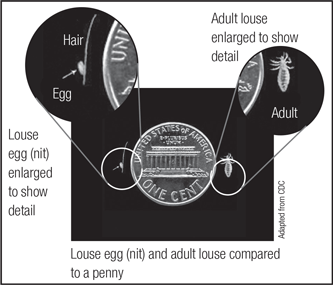
Head lice are tiny bugs about the size of a sesame seed (2–3 mm long [mm stands for millimeter]). Their bodies are usually pale and gray, but their color may vary. One of these tiny bugs is called a louse.
Head lice feed on small amounts of blood from the scalp. They can't survive more than 1 day without a blood meal.
What are nits?
Lice lay and attach their eggs to hair close to the scalp. The eggs and their shell casings are called nits. Lice eggs are oval and about the size of a knot in thread (0.8 mm long and 0.3 mm wide) and usually yellow to white.
Some nits may blend in with some people's hair color, making them hard to see, and are often confused for dandruff or hair spray droplets. Nits attach to the hair with a sticky substance that holds them firmly in place. After the eggs hatch, the empty nits stay on the hair shaft.
What is the life cycle of head lice?
Head lice live about 28 days. They develop in 3 phases: egg (also called a nit), nymph, and adult louse.
Egg or nit. Eggs or nits hatch in 7 to 12 days, depending on the surrounding temperature. Eggs are usually found within 4 to 6 mm of the scalp and do not survive if they are farther away.
Nymph. The nymph looks like an adult head louse but is much smaller (about the size of a pinhead [1.5 mm]). Nymphs become adults about 9-12 days after hatching.
Adult louse. An adult female louse can lay up to 10 eggs a day. It takes only about 12 to 14 days for newly hatched eggs to reach adulthood.
This cycle can repeat every 3 weeks if head lice are left untreated.
How common are head lice?
Head lice are most common in preschool- and elementary school–aged children. Each year millions of school-aged children in the United States get head lice. However, anyone can get head lice. Head lice are found worldwide.
How do head lice spread?
Head lice are crawling insects. They cannot jump, hop, or fly. The main way that head lice spread is from close, prolonged head-to-head contact. There is a very small chance that head lice will spread by sharing items such as combs, brushes, hats and sports helmets.
What are symptoms of head lice?
Itching on the areas where head lice are present is the most common
symptom. However, it may take up to 4 to 6 weeks after lice get on the scalp before the scalp becomes sensitive to the lice saliva and begins to itch. Most of the itching happens behind the ears or at the back of the neck. Also, itching caused by head lice can last for weeks, even after the lice are gone.
How do you check for head lice?
Regular checks for head lice are a good way to spot head lice before they have time to multiply and infest (are present in large numbers) your child's head.
Seat your child in a brightly lit room.
Part their hair.
Look for crawling lice and for nits on your child's scalp a section at a time.
Live lice are hard to find. They avoid light and move quickly.
Nits will look like small white or yellow-brown specks and be firmly attached to the hair near the scalp. The easiest place to find them is at the hairline at the back of the neck or behind the ears. Nits can be confused with many other things such as dandruff, dirt particles or hair spray droplets. The way to tell the difference is that nits are firmly attached to hair, while dandruff, dirt or other particles are not.
Use a fine-tooth comb (such as a louse or nit comb) to help you search the scalp section by section.
What is the comb-out method for lice?
The comb-out method can be used to help check for nits and head lice or to help remove nits and head lice after head lice treatment. However, the comb-out method usually doesn't work on its own to get rid of head lice.
Here is how you use the comb-out method:
Step 1: Wet your child's hair.
Step 2: Use a fine-tooth comb (louse or nit comb) and comb through your child's hair in small sections.
Step 3: After each comb-through, wipe the comb on a wet paper towel. Examine the scalp, comb, and paper towel carefully.
Step 4: Repeat steps 2 and 3 until you've combed through all of your child's hair.
How do you treat head lice?
Check with your child's doctor before beginning any
head lice treatment. The most effective way to treat head lice is with head lice medicine. After each treatment, using the comb-out method every 2 to 3 days for 2 to 3 weeks may help remove the nits and eggs.
Head lice medicine should be used only when it is certain that your child has living head lice. Remember, check with your child's doctor before starting any head lice medicine. Also, when head lice medicines are used, it is important to use them safely as directed.
Here are some safety guidelines for lice treatments:
Follow the directions on the package exactly as written.
Never let children apply the medicine. Medicine should be applied by an adult.
Always rinse the medicine off over a sink and not during a shower or bath, so the medicine doesn't run off the head onto other areas of skin. Place your child's head over a sink and rinse the medicine off with warm water (not hot water).
Never place a plastic bag on a child's head.
Do not leave a child alone with medicine in his or her hair.
Store medicine in a locked cabinet, out of sight and reach of children.
Check with your child's doctor before beginning a second or third medicine. Your child may just need to repeat the same medication, or switch to a new one.
Ask your child's doctor if you have any questions or if treatments you have tried have not gotten rid of lice.
Warning about dangerous home remedies for lice
Never use dangerous products like gasoline or kerosene or medicines made for use on animals! Also, do not use home remedies, such as petroleum jelly, mayonnaise, tub margarine, essential oils or olive oil, because no studies prove they work.
What head lice medicines are available?
Check with your child's doctor before beginning any treatment. See chart, below, for a list of head lice medicines approved by the U.S. Food and Drug Administration.
Head Lice Medicines |
Permethrin lotion (1%)
Brand name products: Nix, Elimite and Acticin
| No prescription needed. Apply to shampooed and towel-dried hair; then rinse off after 10 minutes. Do not shampoo for 24-48 hours afterward. Kills lice; does not kill lice eggs.
Retreatment is recommended between days 9 and 10 if live lice are seen.
Approved for use in children 2 months and older.
|
Pyrethrin-based product (shampoo or hair mousse)
Brand name products: RID, A-200, Pronto, R&C, Triple X and Licide
| No prescription needed. Apply to dry hair and rinse off after 10 minutes. Do not shampoo for 24-48 hours afterwards. Kills lice; does not kill lice eggs. Retreatment is recommended between days 9 and 10. Approved for use in children 2 years and older.
|
Ivermectin lotion (0.5%)
Brand name product: Sklice
| No prescription needed.
Apply to dry hair and rinse off after 10 minutes. Do not shampoo for 24-48 hours afterwards. Kills lice; does not kill lice eggs. However, prevents newly hatched lice from living. Only 1 application is needed.
Do not use veterinary formulations of ivermectin.
Approved for use in infants and children 6 months and older.
|
Malathion lotion (0.5%)
Brand name product: Ovide
| Prescription needed. Apply to dry hair and rinse off after 8–12 hours. Do not shampoo for 24-48 hours afterwards. Kills lice and lice eggs. A second treatment is recommended in 7–9 days if live lice are seen. Approved for use in children 6 years or older. Strong odor.
Flammable.
|
Spinosad topical suspension (0.9%)
Brand name product: Natroba
| Prescription needed. Apply to dry hair and rinse off after 10 minutes. Do not shampoo for 24-48 hours afterwards. Kills lice and lice eggs. A second treatment is recommended in 7 days if live lice are seen. Approved for use in children 6 months of age and older.
|
Ivermectin 3-mg tablets
| Prescription needed.
Use only when other medications have failed.
A second treatment is recommended in 9-10 days if live lice are seen. Can be used at any age, as long as weight is at least 33 pounds.
Do not use veterinary formulations of ivermectin.
Approved for use in adults for head lice, and used in children for other infections.
|
What else do I need to know about treating head lice?
You may want to wash your child's clothes, towels, hats, and bed linens in hot water and dry on high heat if they were used within 2 days before head lice were found and treated. You do not need to throw these items away. Items that cannot be washed may be sealed in a plastic bag for 2 weeks or dry-cleaned..
Do not spray pesticides in your home. They can expose your family to dangerous chemicals and are not needed when you treat your child's scalp and hair properly.
All household members and close contacts should be checked and treated for head lice if necessary.
About school "no-nit" policies
Some schools have "no-nit" policies stating that students who still have nits in their hair cannot return to school. The American Academy of Pediatrics and National Association of School Nurses discourage such policies and believe a child should not miss or be excluded from school because of head lice.
Remember
Head lice don't put your child at risk for any serious health problems. Products should be used only if those products are safe. If your child has head lice, work quickly but safely to treat your child to prevent the head lice from spreading.
More information
About Dr. Nolt
 Dawn Nolt, MD, MPH, FAAP is a Professor of Pediatric Infectious Diseases at Oregon Health & Science University Doernbecher Children's Hospital in Portland. Dr. Nolt currently serves as medical director of the antimicrobial stewardship program and the department of infection prevention and control at the hospital. She is a member of the American Academy of Pediatrics, and previously served on its Committee on Infectious Diseases. Outside of the hospital, Dr. Nolt enjoys spending time with her husband and daughter, discussing the positive impact of superheroes, both in comic books and real life.