Swimming pools can have a powerful pull on little children―even when it's not swimming time. Those glistening turquoise-blue ripples may look especially inviting to an active toddler or an overly confident preschooler.
Children can slip away from the watchful eyes of adults in seconds. It happens every day. (See "Soraya’s Story," below.)
The American Academy of Pediatrics (AAP)
recommends several ways parents can help keep children safe around home
swimming pools and
hot tubs―in your own backyard, your neighbor's, or on
vacation. It's important to use multiple "layers" of protection, since no single step can prevent all drowning. Read on to learn more.
Fact: Most drownings in kids age 4 and under happen in home swimming pools.
The U.S. Consumer Product Safety Commission (CPSC) studied drownings among children age 4 and under in Arizona, California and Florida, where pools are especially common. It found that nearly 70% of the children were not expected to be at or in the pool, yet they were found in the water. In fact, 46% of the children were last seen inside their home.

Soraya's story
By Sophia Brizeus
 When my daughter Soraya Morgynn Stevens was born, I knew I had the best job in the world: to love, nurture, protect, honor and set an example for her.
Soraya loved the water from the moment she took her first bath. We have a pool at the house and we would swim together; she hated it when it was time to get out of the water. The gates and patio doors at the house were always locked for safety. We were vigilant about that.
She was 22 months when I signed her up for her first swim lesson. But she would never get to learn to swim. I went from planning her second birthday to planning her funeral.
It was a Sunday and our house was busy with cousins, my parents and a family friend visiting. That afternoon, when I thought my daughter was playing with my niece, I heard horrible screaming. When I ran outside, I saw my cousin running, holding my daughter, my world, my heart, in her arms.
Neighbors helped perform CPR on her tiny body. But it was too late.
I've gone over that day in my mind so often since her drowning. How did this happen? Everyone said that all the doors were locked, but my daughter was able to get through three doors and slip past a house full of people to get to the swimming pool.
Since Soraya was laid to rest, I've tried to share my story and push for water safety. I started "Soraya's Love Bugs" on
Instagram and
Facebook to help keep children safe around water. Parents should know this can happen to anybody. No parent should have to experience the pain of losing a child.
Pool fences: a key safety step
Pool fences are for ALL pools, including permanent in-ground pools, above-ground polls and hot tubs.
Drowning is the leading cause of death in children 1-4, and most of these tragedies occur in swimming pools—often in a child’s own backyard or at another home. Most children this age who've drowned wandered outside and fell into a swimming pool that was not fenced off from the house. They slipped out a door, climbed out a window, or even crawled through a doggy door to access the pool.
But, a family swimming pool isn't the only one a child can get into unnoticed. Many drownings among young children take place at the home of a friend, relative or neighbor. Only some individual states and municipalities have laws requiring pool safety fences; there is no national pool fence law. Whenever your child will be in someone else's home, always check for ways your child could access pools and other potential hazards.
Fact: Fences are the most effective, proven way to prevent drowning of young children.
Pool fencing recommendations:
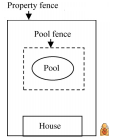 4 feet, 4 sides. The pool fence should be at least 4 feet high and completely surround the pool, separating it from the house and the rest of the yard.
Climb-proof. The fence shouldn't have any footholds, handholds, or nearby objects such as lawn furniture or
play equipment the child could use to climb over the fence. Chain-link fences are very easy to climb and are not recommended as pool fences. (If they are used, make sure openings are 1¾ inches or smaller in size).
Slat spacing. To ensure a small child can't squeeze through the fence, make sure vertical slats have no more than 4 inches of space between them. This will also help keep small pets safe, too.
Latch height. The fence should have a self-closing and self-latching gate that only opens out, away from the pool area. The latch should be out of a child's reach—at least 54 inches from the ground.
Gate locked, toy-free. When the pool is not in use, make sure the gate is locked. Keep toys out of the pool area when it is not in use.
Alarms: an added layer, but not a substitute
Beyond a fence, additional layers of protection such as pool alarms, door and gate alarms, and pool covers can provide some added safety around a pool. Make sure alarms are in good shape with fresh batteries, and keep in mind none are substitutes for a properly installed pool fence.
Drowning is silent. Alarms break that silence.
Pool alarms. Children can drown within seconds, with barely a splash. Swimming pool alarms can detect waves on the water's surface and sound off to attract attention when someone has fallen into the pool, but do not always work with children because they may not make enough waves.
Consider alarms on the pool fence gate and house doors. Door and gate alarms can be equipped with touchpads to let adults pass through without setting them off. House doors should be locked if a child could get to the pool through them. If you have a home security system, ensure that the door alert sound is turned on.
Window guards. These can be especially helpful for windows on the house that face the pool.
Pool covers: what parents need to know
Pool covers should cover the entire pool securely enough that a child can't slip under them. Make sure no standing water collects on top—children can drown in less than 2 inches of water. Power-operated weight-bearing covers are often the safest and easiest to use.
Remember: Floating solar and winter covers are not safety covers and can actually increase drowning risk. Because a floating cover makes the pool surface appear solid, a small child might try to retrieve a ball or other light toy that landed on it and quickly slip underneath—often trapped and hidden from view.
 Other important layers of safety
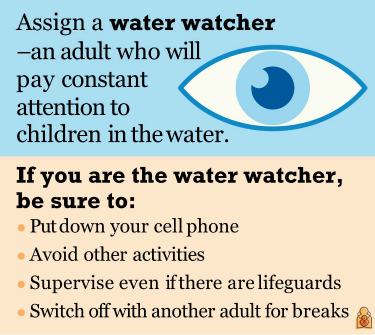
Assign a water watcher.
Their job is to watch all children swimming or playing in or NEAR water―such as on a backyard swing set―even if they know how to swim. This person should provide close, constant, attentive and competent supervision, which means:
staying focused on the children at all times
putting away phones and avoiding distractions
not being under the influence of drugs or alcohol
being ready to act quickly if needed
supervising even if there are lifeguards
switching off with another adult for breaks
Life jackets
Put your child in a properly fitted U.S. Coast Guard approved
life jacket when around or near open water. Young children and weaker swimmers may also benefit from wearing life jackets near pools. Avoid floaties, water wings, or inflatable toys—they are not safe substitutes.
Swim lessons
The AAP recommends
swim lessons as a layer of protection against drowning that can begin for many children starting at age 1.
Learn more here.
CPR training
Parents, caregivers, and pool owners should learn
CPR and how to
get emergency help. Keep equipment approved by the U.S. Coast Guard, such as life preservers and life jackets at poolside.
Check the water first
If a child is
missing, check the pool or spa first—even if you don't think they could get in there. This is especially important if your child is prone to
wandering.
Spread the word
Share this information with family, friends, neighbors. Drowning can happen to any family.
More information