Learning to swim should be a priority for every family. It's an important life skill that can play a key role in helping to prevent drowning―a top cause of death among children. Children, and their parents, need to learn how to swim to help keep time in the water safe and fun!
Here are some tips from the American Academy of Pediatrics (AAP) on the best time to start
swim lessons and what to look for in a quality learn-to-swim program.
When should my child learn to swim?
The AAP recommends swim lessons as a layer of protection against drowning that can begin for many children starting at
age 1. However, keep in mind that children develop at different rates, and not all are ready to begin swim lessons at exactly the same age.
When deciding whether your child is ready for swim lessons, consider their emotional maturity, physical and developmental abilities and limitations and comfort level in the water. If you’re unsure, your pediatrician can help you decide when your child is ready and talk through any concerns you have.
Parent-child toddler & preschool swim classes can benefit many families
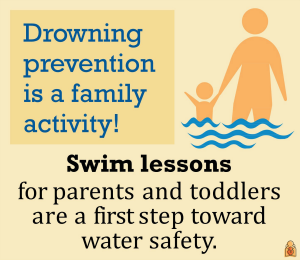
Studies suggest that water competency and survival skills training through swim lessons can help reduce drowning risk for children between ages 1-4 years old. Many children learn to walk at 1 year and become more mobile. This puts them at risk of gaining access to water, such as a
backyard pool.
Classes that include both parents and their children also are a good way to introduce water safety habits and start building swim readiness and basic water survival skills, such as back floating. If your child seems ready, it's a good idea to start lessons early.
Swim lessons for children ages 4 and up: a must for most families
By their
4th birthday, if they havn't already started, most children are ready for swim lessons. At this age, they usually can learn basic water survival skills beyond back floating, such as treading water and getting to an exit point.
By
age 5 or
age 6, most children in swim lessons can master the front crawl. If your child hasn't already started in a learn-to-swim program, now is the time!
Does AAP recommend infant swim classes for babies less than a year old?
No, because there is currently no evidence that infant swim programs for babies under 1 year old lower their drowning risk.
Some infants age 6-12 months can be trained to reflexively float on their backs, face up, but may not be developmentally able to swim. Infants this age may show reflex "swimming" movements but can't yet raise their heads out of the water well enough to breathe.
It's OK to enroll in a parent-child water play class to help your infant get used to being in the pool, though; this can be a fun activity to enjoy together. If you are thinking about other types of infant swim classes, please talk with your pediatrician. They can help you consider the physical and developmental abilities and limitations of your child.
Remember, swim lessons don't make kids "drown proof."
Always keep in mind that
swim lessons are just one of several important layers of protection needed to help prevent drowning.
Another key layer is constant, close, and focused supervision when your child is in or near a pool or any body of water.
It also is essential to block access to pools during
non-swim time. The Consumer Product Safety Commission found that 69% of children under the age of 5 years were not expected to be in the water at the time of a drowning.
What should I look for when choosing swim lessons?
Look for classes and instructors that follow guidelines focused not just on swim stroke techniques, but broader
water survival competency skills.
All children should learn how to get back to the surface from underwater, propel themselves at least 25 yards, and get out of the water, for example. Instructors should evaluate children's progress and give ongoing feedback on their skill levels.
For children of all ages, look for programs that:
Have experienced, qualified instructors. Swim instructors should be trained and certified through a nationally recognized learn-to-swim curriculum. There should also be lifeguards on duty who have current CPR and First Aid certification.
Teach good safety habits in, on, and near water. Children should learn to never swim alone or without adult supervision. Instructors should teach children to always ask for permission from parents, lifeguards, or swimming instructors before they get into a pool or natural bodies of water like a lake.
Teach what to do if they end up in the water unexpectedly. This includes practicing water competency skills such as self-rescue. Lessons should provide training with a variety of realistic conditions, such as falling in and swimming in clothes. Older children also should learn what to do if they see someone else in the water who is struggling, and how to get help.
Let you watch a class first to see first-hand if it is right for your child. Not all swim lessons are the same, and parents should investigate options to choose the best fit. Are children swimming most of the time, or are there long periods of inactivity where they are awaiting their turn? Do children get one-on-one attention? Are the instructors friendly and knowledgeable?
Require multiple sessions. Once children start lessons, you should be able to see gradual but consistent progress in their abilities over time. Continue lessons at least until your child masters basic water competency skills. Refresher sessions may be needed.
Adapted aquatics. Swim lessons and recreational aquatics can be adapted for children with
special health needs and developmental disabilities, such as those with
autism. These programs reduce drowning risk and can help improve swim competency in children and teenagers with autism (and can also benefit the child's motor skills, behavior and mood).
In addition, for children under age 4, look for programs that:
Provide an age-appropriate atmosphere. Your child should feel safe and secure during lessons, with activities that support their social, intellectual, physical, and emotional development. However, children need to develop a healthy respect for water, as well.
Include "touch supervision." Whenever infants and toddlers are in or around water—even during swim lessons―an adult should be within arm's reach to provide "touch supervision." Parent participation should be encouraged, especially since it also helps families know what to practice in between classes. If you can't be in the water with your child or closely observe them during lessons, private classes that offer 1-on-1 instruction may be a better option.
Maintain water purity. Young children are more likely to swallow or breathe in water, so water disinfection and maintaining proper chlorine levels is really important. A good program should also require the child to wear a swimsuit that is snug-fitting at the legs to help avoid spreading body waste into the water.
Keep the water warm. Hypothermia is a greater risk at this age. Ideally, swim and water safety classes for children age 3 and younger should be in water heated to 87 to 94 degrees Fahrenheit.
Finding affordable swim lessons in your community
In some communities, children face higher risks around water because swim lessons and safe places to swim aren't always easy to find or afford.
The good news is that there are often ways to help find low‑cost, local swim lessons that work for your family and your schedule. Many YMCAs, parks and recreation departments, schools and community organizations offer low‑cost or free swim lessons, especially during the summer months. Some programs are designed specifically for young children or families with limited access to pools.
Your child's pediatrician, school office or local recreation center may also be able to help you find programs in your area. If lessons aren't available right away, remember that swim lessons are just one layer of water safety. Close
supervision, pool fences and
life jackets are all important ways to help keep children safe until formal lessons are possible.
How to supervise your child in or near water
Proper supervision in the water—even if your child is learning how to swim―is one of the most important ways to help prevent drowning. Drowning is quick, silent, and much more common than most families realize. It happens every day to children with loving, attentive parents and caregivers.
To effectively supervise and keep your child safe during swim time, keep in mind:
Pay close, constant attention. Do not get distracted with other activities (such as reading, playing games, using the cellphone, or mowing the lawn), even if lifeguards are present.
Avoid using alcohol or drugs around the water, especially when supervising others.
For younger children and weak swimmers, get in the water with them."Touch supervision" is essential! Even if you are not swimming but there is a pool or body of water nearby, always keep children within arm's reach. If you must leave, take the child with you.
Don't leave a baby or young child in or near any body of water under the care of another child.
Especially during parties or picnics at the pool or lake, when it's easy to get distracted, assign a "water watcher" whose job is to constantly keep eyes on the child in or near the water. Take turns, passing along a water watcher card to the next responsible adult after a set time (such as every 15-20 minutes).
Remember that the leading drowning risk for toddlers age 1-4 is unexpected, unsupervised access to water. Children are naturally curious and commonly
slip away unnoticed during non-swim times.
Always use life jackets when in, on or near natural bodies of water, such as lakes or rivers. Make sure they fit properly and are approved by the U.S. Coast Guard. Weak or non-swimmers should also wear life jackets when at a pool or water park.
Know how to recognize signs of distress and respond when there is trouble. Everyone, including parents, caregivers and older children, should learn CPR and safe rescue techniques to respond to a drowning incident. Water safety is a family affair!
What to remember about swim lessons for kids
Enrolling in quality swim lessons―once your child is ready for them―is one of several essential ways to help prevent drowning. And if you
haven't learned to swim yet yourself, now is the perfect time for you to take lessons, too!
Talk with your pediatrician if you have any questions about whether your child is developmentally ready for swim lessons and how to find a quality program for your family.
More information
About Dr. McCallin
 Tracy McCallin, MD, FAAP, a member of the American Academy of Pediatrics Council on Injury, Violence & Poison Prevention, is an attending physician in the pediatric emergency department at Rainbow Babies & Children’s Hospital in Cleveland. Dr. McCallin has served as co-lead of the 2024 American Heart Association and American Academy of Pediatrics
Focused Update on Special Circumstances: Resuscitation Following Drowning. She is currently an Associate Professor of Pediatrics at Case Western Reserve University and Associate Chief Quality Officer for Education at Rainbow.
Tracy McCallin, MD, FAAP, a member of the American Academy of Pediatrics Council on Injury, Violence & Poison Prevention, is an attending physician in the pediatric emergency department at Rainbow Babies & Children’s Hospital in Cleveland. Dr. McCallin has served as co-lead of the 2024 American Heart Association and American Academy of Pediatrics
Focused Update on Special Circumstances: Resuscitation Following Drowning. She is currently an Associate Professor of Pediatrics at Case Western Reserve University and Associate Chief Quality Officer for Education at Rainbow.
|
About Dr. Shenoi
 Rohit P. Shenoi, MD, FAAP, is a Professor of Pediatrics at Baylor College of Medicine and an Attending Physician in the Emergency Center at Texas Children's Hospital. He is a member of the Council on Injury, Violence, and Poison Prevention of the American Academy of Pediatrics. Rohit P. Shenoi, MD, FAAP, is a Professor of Pediatrics at Baylor College of Medicine and an Attending Physician in the Emergency Center at Texas Children's Hospital. He is a member of the Council on Injury, Violence, and Poison Prevention of the American Academy of Pediatrics.
|