By: Kristina Bryant, MD, FAAP
Many people don't realize how serious influenza (flu) illness can be, even for previously healthy kids and teens. (See "Why Flu Vaccines Top Our Back-to-School List Each Year," below.) Children also play a role in spreading the flu in their homes, schools and communities.
A flu vaccine is the best way to protect against serious complications of flu. Last season, about 85% of kids who died from the flu were not vaccinated. Influenza viruses change yearly. All children age 6 months and older need a flu vaccine every year. Children should get their influenza immunization once the vaccines become available, especially if they need two doses this season. That way they will be protected before flu starts circulating in your community. It takes about two weeks after the shot to build immunity.
Which flu vaccines are available?
There are two types of influenza vaccines available. The first is what many people call the "flu shot." The second comes as a nasal spray.
All the vaccines available for children this year protect against three different influenza viruses (two A viruses and one B virus). During flu season, multiple different flu viruses may circulate. Sometimes the viruses change during the flu season.
Should I get the shot or nasal spray for my child this year?
The American Academy of Pediatrics (AAP) recommends that as many children as possible get a flu vaccine every year. Any licensed vaccine that is available for your child’s age and health status is recommended. To be eligible for the nasal flu vaccine spray, children need to be at least two years old and free of any underlying medical conditions.
Influenza vaccination should not be delayed to get a specific product, including a thimerosal-free product. Read more about thimerosal-containing vaccines in "Vaccine Ingredients: Frequently Asked Questions," and in this
AAP Factchecked article.
Can kids get a flu vaccine and other vaccinations at the same time?
Yes. Talk with your pediatrician about your child getting the flu vaccine along with other recommended immunizations. Flu vaccine can also be given at the same visit as the COVID vaccine and respiratory syncytial virus (RSV) immunization. 
Why Flu Vaccines Top Our Back-to-School List Each Year
By Jennifer Pool Miller
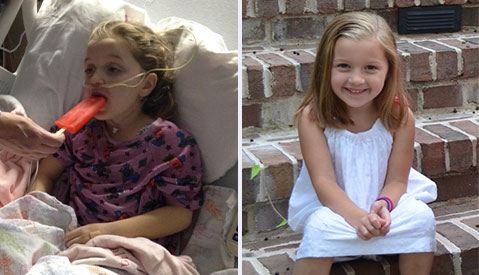 Our daughter, Caroline, was very active, physically fit and healthy. She swam several times a week and participated in weekly gymnastics lessons.
She had been vaccinated against the flu every year, except one. When she was 5 years old, influenza nearly stole her life. That year, the vaccine wasn't readily available prior to the beginning of school. Once the busy school year began, a flu shot fell off our radar.
As winter break approached, Caroline came home from school with the sniffles and a mild cough. She has mild asthma and occasionally uses a nebulizer. But as the evening progressed, Caroline's breathing became more labored than usual. We called her pediatrician, who advised us to alternate doses of her asthma medications and to keep in touch. But by 1 a.m. her condition had worsened. The pediatrician urged us to take Caroline to the hospital, just to be safe.
Caroline was diagnosed with influenza A and double pneumonia. Doctors placed her on oxygen and monitored her breathing. She was transferred by ambulance to another hospital with a dedicated pediatric unit, but she slipped into life-threatening acute respiratory distress syndrome and needed to be transported by helicopter to the Children's Hospital of Philadelphia.
She faced a long and frightening list of complications: flu, pneumonia, severe sepsis, septic shock, hypoxemia and was at risk of cardiorespiratory failure. For the next two weeks, Caroline remained in a medication-induced coma, intubated, and on an oscillating ventilator at the pediatric intensive care unit.
Finally, on Christmas Day, Caroline's condition started to take a turn for the better. The recovery process was agonizing, with two steps forward and one step back. And after a long three weeks, she was able to go home.
We are fortunate that our daughter was able to fight her way back. Her experience has changed our entire family's lives forever. I now encourage families to consider the flu shot a back-to-school essential.
Jennifer Pool Miller serves as treasurer for Families Fighting Flu, a nonprofit organization dedicated to saving lives and reducing hospitalizations by protecting against flu. A strong advocate for annual flu vaccination, joined Families Fighting Flu in 2013 after her daughter Caroline's frightening battle with the flu. Her family established the Caroline Miller Endowed Fund for Nursing Education and "Katie and Caroline P.I.C. YOU!" Award at the Children's Hospital of Philadelphia to support continuing education for nurses, in honor of the role the CHOP nursing staff played in Caroline's care and recovery.
What about allergies to flu vaccines?
A child who had an allergic reaction after a flu vaccine in the past should be seen by an allergist. The allergist can help parents decide if their child should receive their annual flu vaccination. A child with a known history of
egg allergy can receive the flu vaccine without any added steps beyond those recommended for all vaccines.
Where should I go for my child's flu vaccine?
Many pediatricians offer flu shot clinics, including curbside and drive-through clinics. The pediatrician's office has your child's health information. That makes it easy to keep track of the flu shot in your child's health record.
If they get a flu vaccine somewhere else, remember to share this information with the pediatrician so the vaccination is included in your child's health record.
Some children who are eligible for the nasal spray may be able to receive the vaccine at home. The vaccine can be ordered from an online pharmacy for children who meet eligibility requirements.
Don't let the flu stop you and your family!
Most people who get the flu are sick for at least a week. But some people get much sicker. Getting vaccinated is the best way to prevent influenza and serious health problems—especially for kids under 5 or those with conditions like asthma or diabetes. For example, flu can lead to pneumonia. Kids with flu also can develop brain swelling as well as
febrile and non-febrile
seizures.
The flu vaccine keeps people out of the hospital—it stops serious illness and deaths from influenza.
There's no need to wait, even if your child received the previous year's flu vaccine in March or April. Children 6 months to 8 years of age should receive two doses if this is the first time they are being vaccinated against influenza, or if they have only received one dose of flu vaccine ever before July 1. The doses are given four weeks apart. If your child is 8 years old and requires 2 doses of influenza vaccine, they should receive both doses even if they turn 9 years old between the first and second dose.
We have a vaccine for flu, unlike many other respiratory viruses that make kids sick. Let's protect our children from flu when we can.
More information
About Dr. Bryant
 Kristina A. Bryant, MD, FAAP, a pediatric infectious diseases specialist at the University of Louisville and Norton Children’s Hospital, is a member of the American Academy of Pediatrics (AAP) Committee on Infectious Diseases, lead author of the annual AAP influenza policy statement and technical report, and lead for
Red Book Online. She also is past president of the Pediatric Infectious Diseases Society.
Kristina A. Bryant, MD, FAAP, a pediatric infectious diseases specialist at the University of Louisville and Norton Children’s Hospital, is a member of the American Academy of Pediatrics (AAP) Committee on Infectious Diseases, lead author of the annual AAP influenza policy statement and technical report, and lead for
Red Book Online. She also is past president of the Pediatric Infectious Diseases Society. |