By: Keri Wallace, MD, FAAP
Pityriasis rosea is a common rash that children can get. It usually starts as one round spot of rash on the skin. Many smaller spots of rash show up a week or two later.
The rash is most common in older kids, teens and young adults. We occasionally see it in infants and younger children.
Is pityriasis rosea contagious?
Fortunately, pityriasis rosea is is not dangerous or contagious, and goes away by itself without any treatment. However, the rash can last a few months before it goes away.
What causes it?
We don't know what causes pityriasis rosea. It is not caused by a fungus or bacteria.
What does pityriasis rosea look like?
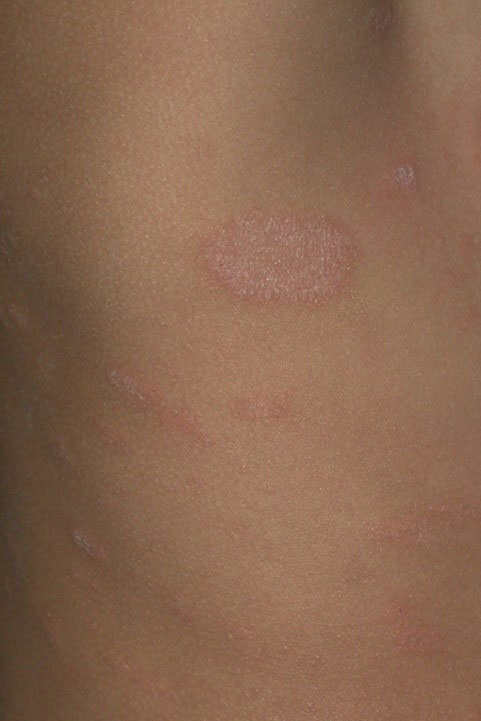 Pityriasis rosea looks like round or oval flat spots of rash on the skin. The spots may be flaky.
Where do the rash spots appear?
These spots mostly show up on the chest, back, belly, arms, legs and neck. Pityriasis rosea doesn't usually spread to the face.
"Christmas tree" rash pattern
The rash spots from pityriasis rosea can form a "Christmas tree" pattern of lesions on the chest or back.
What color is the rash?
The rash may look pink or red in children with lighter skin. In darker skin, the rash may appear purplish or more brown than red.
Are there other symptoms?
The rash is usually the only symptom with pityriasis rosea. The rash can be a little itchy for some people. Some children may also feel a little more tired before or during the rash. Most kids with pityriasis rosea feel normal otherwise.
How is it diagnosed?
A doctor can usually diagnose pityriasis rosea by asking questions and looking at the rash. No special tests are needed for most cases.
How is pityriasis rosea treated?
Pityriasis rosea is not dangerous or contagious. It goes away all by itself within one to two months. It does not leave any scars. Brown spots where the rash was can last a few more months but fade away eventually.
When the rash is itchy & very bothersome
Your doctor may prescribe a cream to lessen the itch if it is very bothersome. Antihistamines may also be used. These are medicines taken by mouth that improve itchiness until the rash goes away by itself.
Bathing in lukewarm water, not hot water, can be helpful, as well as using a moisturizing cream on the skin every day. Exposure to sunlight or ultraviolet light treatments are sometimes recommended to help the rash go away more quickly if it is very severe.
More Information
About Dr. Wallace
 Keri Wallace, MD, FAAP, is a board-certified pediatrician who has been a member of the American Academy of Pediatrics (AAP) since 2001. Dr. Wallace is a general academic pediatrician at Connecticut Children's Medical Center in the Primary Care Center and an Assistant Professor of Pediatrics for the University of Connecticut School of Medicine. Dr. Wallace has a special interest in pediatric dermatology and serves as a member on the Society of Pediatric Dermatology Education Committee and the AAP Section on Dermatology. Keri Wallace, MD, FAAP, is a board-certified pediatrician who has been a member of the American Academy of Pediatrics (AAP) since 2001. Dr. Wallace is a general academic pediatrician at Connecticut Children's Medical Center in the Primary Care Center and an Assistant Professor of Pediatrics for the University of Connecticut School of Medicine. Dr. Wallace has a special interest in pediatric dermatology and serves as a member on the Society of Pediatric Dermatology Education Committee and the AAP Section on Dermatology.
Pityriasis rosea images provided by Sarah Stein, MD, FAAD, FAAP. |